Next up in the song analysis series is Shadowboxer from my 2023 album, Hourglass of Exile. Fair warning, I don’t think I have as many memorable stories about this song, so we’ll see how much I can pull together for this post. Haha. Wish me luck, see you at the bottom of the page, hopefully.
It’s funny looking back at writing some of these songs because, for me, they’ve just existed in one form or another for a few years before the final album ended up being released. So, that makes pulling specific details about how the songs were written kind of challenging in a way because I feel like I was an entirely different person when I wrote them compared to who I am now, trying to reflect on them.
Shadowboxer was definitely written while I was still in college, probably around 2013-2014 would be my guess. The funny thing is that, for the most part, the album Hourglass of Exile was written sequentially, meaning I wrote the songs in the order of the album, except for That’s a Nice Coat, which was initially written for a custom video game level (more on that in a future post). But Shadowboxer would have come together around the same time I wrote Seven Stars, which I may or may not cover in this series. If you listen to that song, you can hear where it gets its name from, hehe.
But Shadowboxer does have its roots from one of my music classes in college. I believe it was either Music History or Analytical Techniques, and we were learning about Steve Reich, who is a composer of some very interesting pieces. I can’t remember most of them, but he’s well known for this like “phase shifting” technique that he employs in his works. Some pieces of his are literally just an exercise in this technique, probably the most famous of which is “Clapping Music”.
What he does is he creates this short one or two bar phrase that just repeats over and over, usually doubled by two musicians. This phrase is repeated in unison until one of the parts gets offset by one beat. The other part remains steady throughout the entire piece. So you get this very interesting play on rhythm and timbre at times, depending on which piece of his you’re listening too. “Clapping Music” is literally just clapping, and it demonstrates this technique. Other pieces of his, like “Come Out”, does this same technique but with a sound clip that loops a vocal sample of someone saying “Come out to show them”, and very gradually, the loop goes out of sync with itself until it gets all funky and weird sounding. Check it out on Youtube if you’re interested in hearing how these pieces sound.
So anyways, after learning about Steve Reich one day in class, I go upstairs to this common rest area, where I likely spent more time than actually going to class, simply because of how much down time I had between my classes. I would go in here and take naps daily, and it was just funny because usually this area was filled with other students talking, playing euchre and whatever else. Anyways, I’d usually have a guitar with me at school, so I started applying these Steve Reich techniques to my own tunes. This is more or less how Shadowboxer got its start. There’s a chug pattern during the verses of this song that follows this technique of taking the same phrase and shifting it by a few notes rhythmically to make it all weird and whatever. Let me show you what I did.
Shadowboxer, guitar 1, verse chug pattern, timestamp 1:28-2:20
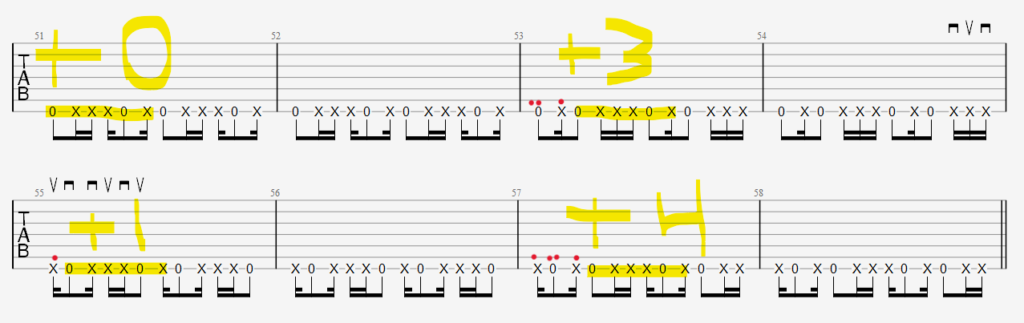
This is the primary iteration of this phase shifting idea I used in this song. I created a 2 beat rhythmic phrase (highlighted in yellow), where the accents are the 0s above, and the Xs are dead notes on the guitar string. As the riff proceeds, I shift it by different number of 16th notes to make this a weird proggy djent-style riff. I use the initial iteration of the riff as the default version, so it’s +0 notes in its offset. The next offset is 3 16th notes. Compare it to the +0 version and you’ll see it’s got 3 extra 16th note beats (red dots) at the beginning before the phrase properly appears in the bar. As the riff goes on, you’ll see the next version is +1 16th note, and then finally +4 16th notes. I chose the number of notes per offset kind of at random and by feel, mostly. A riff sometimes isn’t much if it doesn’t feel good to play.
This riff is actually pretty fun to play, and all the accents generally fall on an upstroke, minus the initial downstroke that starts the riff, but as I noted on the score, there’s one moment going from the +3 version to the +1 version where you have to land on the accent with a downstroke, and then follow it with another downstroke to help keep the accents falling on the upstrokes. A little bit of guitar specific notes, for all you nerds out there, hehe.
I take this phase shifting idea a step further in the section that follows this verse and also add some interplay between the two guitar parts. Let me show you what’s going on.
Shadowboxer, guitar 1, retrograde chug pattern, timestamp 2:21-2:46
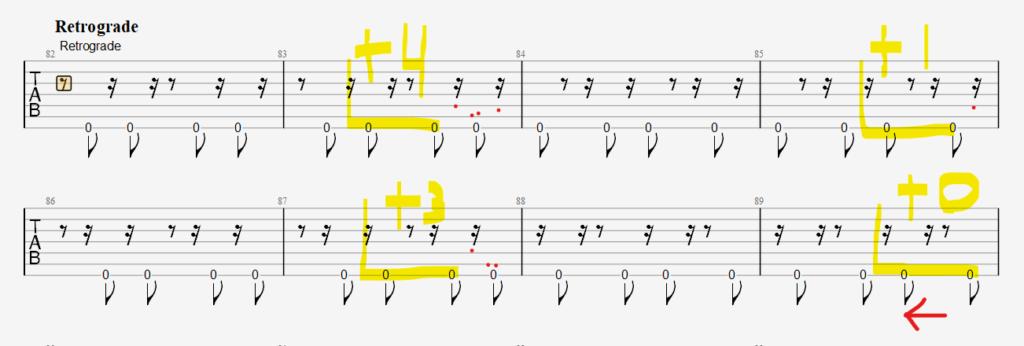
So guitar 1 gets rid of the X dead notes on the string and just does the accent pattern that it was doing previously. Though, just to be annoying, I took the accent pattern from the verse and just did it backwards. How stupid, right? As you can see, if you read it backwards in the screenshot above, going from the red arrow back to the beginning, the accent pattern is exactly the same, but just backwards. The highlighted yellow areas are the 2 beat phrase, if read right to left. So, just a quick and easy way to more or less come up with another interesting rhythmic pattern. I think Steve Reich did this too, but I forget where. Since beginning writing this post, I actually revisited Steve Reich a little bit and found another interesting idea of his that I might rip off in the future, hehe.
Anyways, let me show you what guitar 2 is doing during this retrograde section as a response to this inverted accent thing going on.
Shadowboxer, guitar 2, retrograde chug pattern, timestamp 2:21-2:46
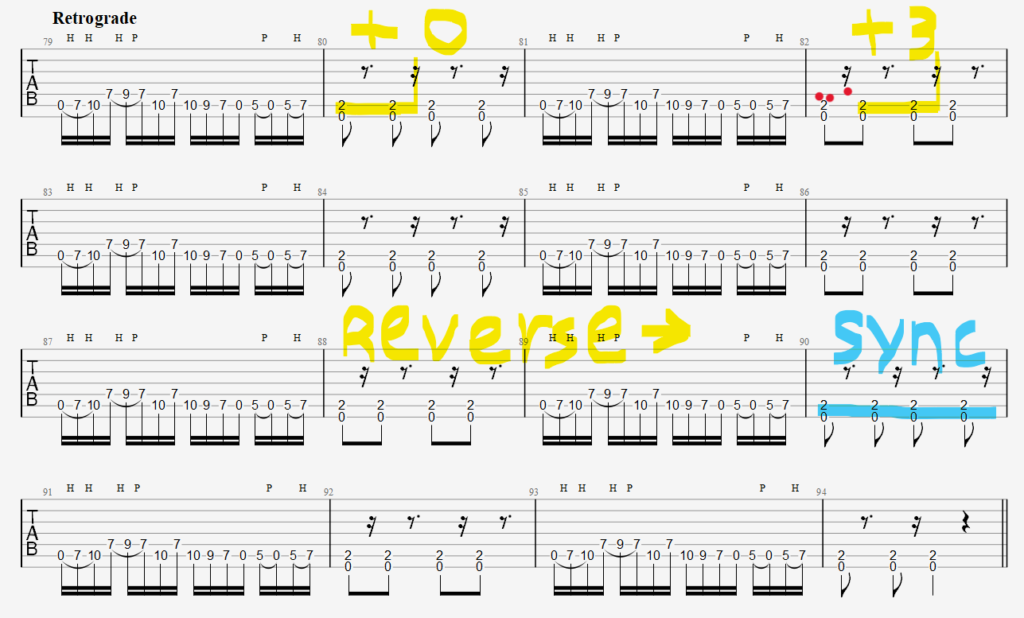
There’s some in between noodly type riff going on here, but I’m mostly interested in the yellow highlighted parts. So, between the noodly bits, I’m again using the same 2 beat accent pattern that’s been used in the verse and also in guitar 1 during this retrograde section. To give it some counter-play between guitar 1 and 2, guitar 2 follows a different offset pattern to that of guitar 1. When guitar 1 is doing it’s inverted +4 thing (which is actually a +5 if you read it from left to right), guitar 2 is doing just the default accent pattern. Then guitar 2 moves to a +3 offset during the next time the accent pattern comes up in the riff. Then these four bars repeat in guitar 2.
Now here comes the interesting part. I do a sort of retrograde, or reversal, of guitar 2’s accent pattern, because this isn’t complicated enough already. So the first four iterations of the accent pattern in this section went +0, +3, +0, +3. Now for the back half of the section, guitar 2 is doing +3, +0, +3, +0. This is important because for one bar, and one bar only, the two guitars are in sync and their accents line up (highlighted in blue). The rest of the accents throughout this entire section have some sort of offset between the two guitars. But not this one bar. It’s totally in unison, which is cool. Kind gives the ear this one moment of something that makes sense, haha.
The thing to keep in mind is that many things appear to be more complicated when dissected. At least I find that to be the case when analyzing musical ideas and motifs. In no way was any of this conceived in the manner in which I just described it, where I was considering how many notes to offset something and how it all works with this degree of detail. It mostly boiled down to me being inspired by the ideas I had learned about from Steve Reich and just experimenting with it until something I thought was cool or interesting emerged. Why not try the same thing but backwards? What would happen? Apparently something I enjoyed enough to commit to an album. I’ve done this same approach with other ideas and found that it wasn’t to my liking, so for me, techniques like this fall more into the realm of experimentation than method, which is something Steve Reich clearly baked into his compositional style.
So the next time you’re writing a song and want to make it weird, channel Steve Reich. Try playing the same thing backwards, or even something as simple as moving it one beat backward or forward. It just goes to show how one little difference can completely change how something sounds and is performed. Ideas like this then can open the door to even more ideas you didn’t have when you started. I can speak from experience with how I wrote Shadowboxer, because once I started using these techniques, it lead me further down the rabbit hole and I really explored them in other areas of the song. So if there’s a moral to pull from this, it’d be open to getting weird with it.
Well then… I think I managed to get more out of this song than I originally thought. Hopefully you found some of this inspiring, or at the very least, interesting. Be sure to check out some of Steve Reich’s music too because it’s pretty thought provoking stuff. Thank you for reading if you made it all the way to the bottom here. Much appreciated for your time.
Until next time, stay weird.
-tB